Semaglutide vs. Tirzepatide vs. Retatrutide: A Head-to-Head Research Comparison
In under a decade, incretin-based research compounds have progressed from single-receptor GLP-1 agonism to dual and now triple-receptor agonism, with each generation adding a distinct metabolic pathway to the underlying mechanism. Semaglutide, tirzepatide, and retatrutide represent these three successive stages, and they are frequently discussed as though they were interchangeable variations on the same compound. Mechanistically, they are not. Each targets a different combination of receptors, is built on a different (if related) molecular scaffold, and is supported by a different depth of published trial data. For researchers designing a comparative protocol — or simply deciding which compound answers a specific research question — understanding those structural and mechanistic distinctions matters more than any single headline efficacy number.
This guide walks through the molecular architecture of all three compounds, compares their published Phase 2 and Phase 3 trial data side by side, and outlines the sourcing and handling standards that apply to this class of long-chain metabolic peptide.
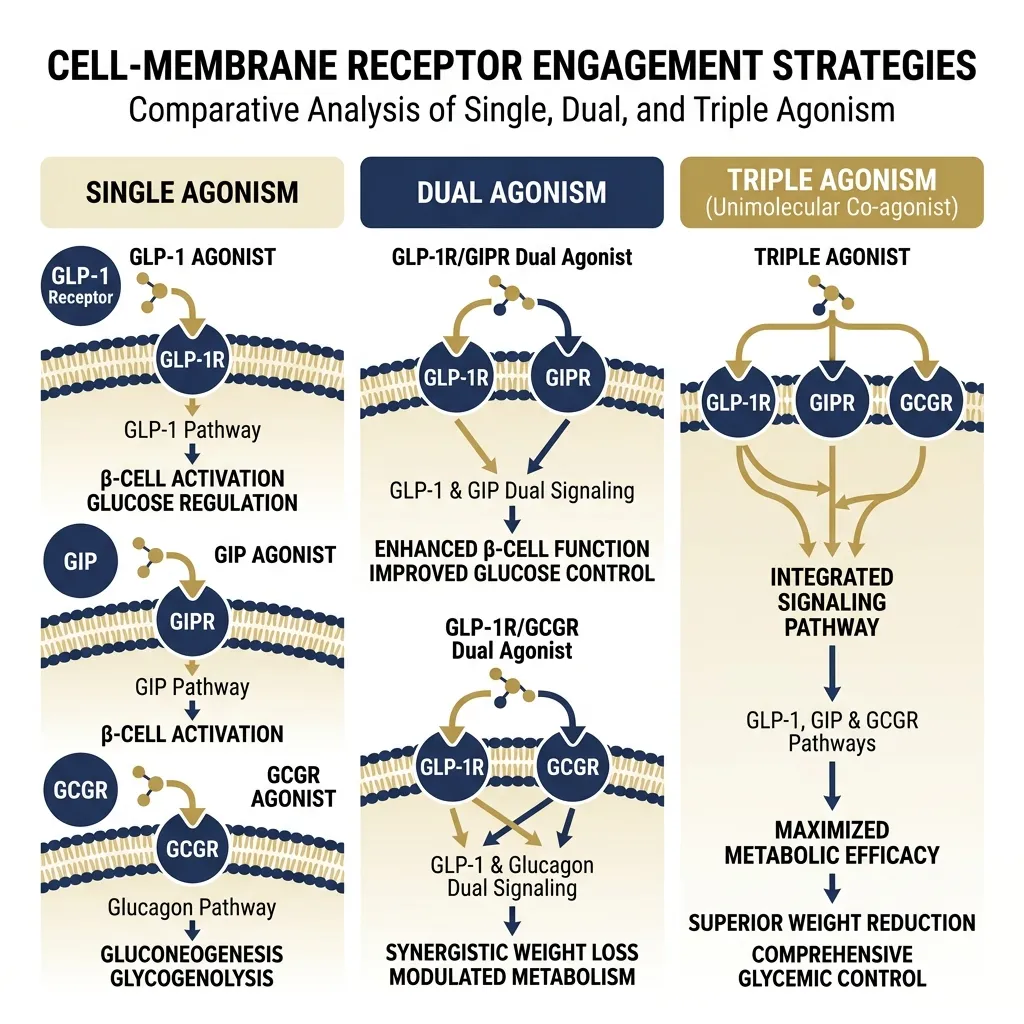
Quick answer: Semaglutide is a single GLP-1 receptor agonist (31 amino acids). Tirzepatide is a dual GLP-1/GIP receptor agonist (39 amino acids). Retatrutide is a triple GLP-1/GIP/glucagon receptor agonist (39 amino acids). Each additional receptor target adds a distinct metabolic pathway — GIP synergy for tirzepatide, hepatic fat oxidation and energy expenditure for retatrutide — and published trial data shows a corresponding step-up in mean weight-related outcomes across the three, from roughly 15% (semaglutide, STEP trials) to roughly 21% (tirzepatide, SURMOUNT-1) to over 24% (retatrutide, Phase 2). All three are Research Use Only compounds, not interchangeable substitutes for one another in a research protocol.
The Incretin Research Landscape: From Single to Multi-Receptor Agonism
Native GLP-1 (glucagon-like peptide-1) is an endogenous incretin hormone secreted by intestinal L-cells in response to nutrient intake, with a plasma half-life measured in minutes due to rapid degradation by the enzyme DPP-4. The entire modern class of metabolic research peptides exists because pharmaceutical chemists found ways to engineer around that limitation — first by stabilizing GLP-1 receptor agonism into a once-weekly research compound (semaglutide), then by adding a second receptor target to broaden the mechanism (tirzepatide), and most recently by adding a third (retatrutide). Each step in that progression was not simply a matter of increasing potency at the same target; it introduced an entirely new signaling pathway into the compound's biology, which is why the three compounds are best understood as three distinct research tools rather than three strengths of the same tool.
Semaglutide: Single-Agonist GLP-1 Mechanism
Semaglutide is a 31-amino-acid peptide engineered as a selective GLP-1 receptor agonist. Its structural modifications — including an attachment of a C18 fatty diacid chain — allow it to bind strongly to circulating serum albumin, which protects the molecule from rapid renal clearance and enzymatic degradation by DPP-4. This single change extends its functional half-life from the few minutes of native GLP-1 to approximately 7 days, making once-weekly research dosing schedules feasible. Mechanistically, semaglutide's effects are confined to GLP-1 receptor signaling: enhanced glucose-dependent insulin secretion, suppressed glucagon release, delayed gastric emptying, and central appetite-regulating effects mediated through GLP-1 receptors in the hypothalamus.
Tirzepatide: The Dual GIP/GLP-1 Agonist Mechanism
Tirzepatide extends this approach by engaging a second receptor. Its 39-amino-acid sequence is engineered to activate both the GLP-1 receptor and the GIP (glucose-dependent insulinotropic polypeptide) receptor simultaneously. GIP is itself a native incretin hormone, and in research models GIP receptor agonism has been associated with synergistic enhancement of insulin secretion and favorable effects on adipose tissue lipid metabolism. The practical research implication is that tirzepatide does not simply amplify GLP-1 signaling — it introduces a second, mechanistically distinct pathway that interacts with the first, which is the leading explanation in the literature for why its published effect sizes exceed those of GLP-1 agonism alone.
Retatrutide: The Triple Agonist and the Glucagon Receptor Component
Retatrutide adds a third receptor target on top of tirzepatide's dual-agonist foundation: the glucagon receptor (GCGR). Its 39-amino-acid backbone incorporates alpha-aminoisobutyric acid (Aib) substitutions at key positions for steric protection against proteolytic cleavage, alongside the same C18 fatty diacid moiety used for albumin binding in the other two compounds. Glucagon receptor agonism is mechanistically distinct from incretin signaling — it is associated in research models with increased energy expenditure and direct stimulation of hepatic fat oxidation, a pathway neither semaglutide nor tirzepatide engages at all. For a full breakdown of retatrutide's molecular architecture and standalone research profile, see our companion guide, Retatrutide Peptide: Complete Research Guide to the Triple Agonist.
Head-to-Head Structural and Mechanistic Comparison
| Property | Semaglutide | Tirzepatide | Retatrutide |
|---|---|---|---|
| Receptor targets | GLP-1R | GLP-1R + GIPR | GLP-1R + GIPR + GCGR |
| Amino acid length | 31 | 39 | 39 |
| Half-life extension mechanism | C18 fatty diacid, albumin binding | C18 fatty diacid, albumin binding | C18 fatty diacid + Aib substitution |
| Approximate half-life | ~7 days | ~5 days | ~5-6 days |
| Distinguishing pathway | None (single target) | GIP-mediated insulin/lipid synergy | Glucagon-mediated hepatic fat oxidation |
| Furthest published trial phase | Phase 3, approved | Phase 3, approved | Phase 3 (TRIUMPH program, 2026) |
Published Efficacy Data: What the Clinical Trials Show
Semaglutide's STEP clinical trial program reported mean body weight reductions of approximately 15% from baseline at 68 weeks in adults with obesity. Tirzepatide's SURMOUNT-1 trial reported mean reductions of approximately 21% at 72 weeks with the highest studied dose. Retatrutide's pivotal Phase 2 trial (Jastreboff et al., 2023, New England Journal of Medicine) randomized 338 adults with obesity across multiple dose tiers over 48 weeks, with the highest-dose (12 mg) cohort demonstrating mean reductions exceeding 24% from baseline — the largest single-compound reduction reported in a controlled obesity trial at the time of publication. That same trial reported measurable reductions in hepatic fat fraction via MRI-PDFF imaging, an effect specifically attributed to the added glucagon receptor pathway. Subsequent Phase 2 data in type 2 diabetes populations (Rosenstock et al., 2023, Lancet) demonstrated significant HbA1c reductions alongside the body-weight effect, and the Phase 3 TRIUMPH-1 program reported topline results in May 2026 confirming a dose-dependent effect at 80 weeks.
It is essential for researchers to understand what this data does and does not represent. These figures describe the FDA-regulated investigational or approved drug product as studied in large, controlled human clinical trials — not the properties of research-grade peptide material sold for laboratory use. Research-grade semaglutide, tirzepatide, and retatrutide are used in preclinical settings to study receptor pharmacology, GPCR signal transduction, and comparative multi-receptor mechanism; they are not for human use, and the clinical trial outcomes above should not be interpreted as claims about research reagent products.
Why Receptor Count Changes the Research Question
A study designed to isolate GLP-1 receptor signaling specifically should use semaglutide, since it is the only one of the three compounds engaging exactly one receptor with no confounding cross-talk from GIP or glucagon pathways. A study investigating GIP-GLP-1 synergy — for instance, its effect on insulin sensitivity in adipose tissue models — requires tirzepatide, because semaglutide cannot produce that interaction and retatrutide introduces a third, uncontrolled variable (glucagon signaling) into the same comparison. A study specifically examining glucagon-mediated hepatic effects, such as hepatic fat oxidation or systemic energy expenditure, requires retatrutide, since neither of the other two compounds engages the glucagon receptor at all. Choosing the wrong compound for a given research question is one of the more common avoidable design errors in comparative incretin research.
Designing a Comparative Protocol Across All Three Compounds
Researchers running head-to-head comparative protocols across semaglutide, tirzepatide, and retatrutide typically hold every non-compound variable constant across matched cohorts: identical administration route, identical dosing schedule and time-of-day, identical reconstitution and storage handling, and identical outcome-measurement protocol. This is what allows any observed difference in outcome to be attributed specifically to the receptor combination each compound engages, rather than to procedural drift between cohorts. Because all three compounds share a broadly similar molecular scaffold — long-chain peptides in the 31-39 amino acid range with a fatty-acid albumin-binding modification — the primary confounders in this type of comparison tend to be sourcing-related (unverified purity or identity of the research material) rather than structural.
Purity, Sourcing, and Verifying Research-Grade Material
Long-chain peptides in this class — 31 to 39 amino acids — are considerably more prone to synthesis errors than shorter research peptides. During Solid-Phase Peptide Synthesis (SPPS), each additional amino acid coupling step carries a small statistical chance of failure, and these small per-step inefficiencies compound over a sequence this long, producing truncated byproducts alongside the correct full-length peptide. Truncated sequences can competitively bind the target receptors without activating them, introducing noise into a research protocol that can be difficult to distinguish from a genuine biological result. This is why researchers should require ≥99% purity confirmed by independent third-party HPLC testing, LC-MS or ESI-MS molecular weight verification confirming structural identity against the theoretical value, and a lot-specific Certificate of Analysis accompanying every batch. Our full guide to reading a peptide Certificate of Analysis covers exactly what to look for in this documentation.

Reconstitution and Storage Considerations
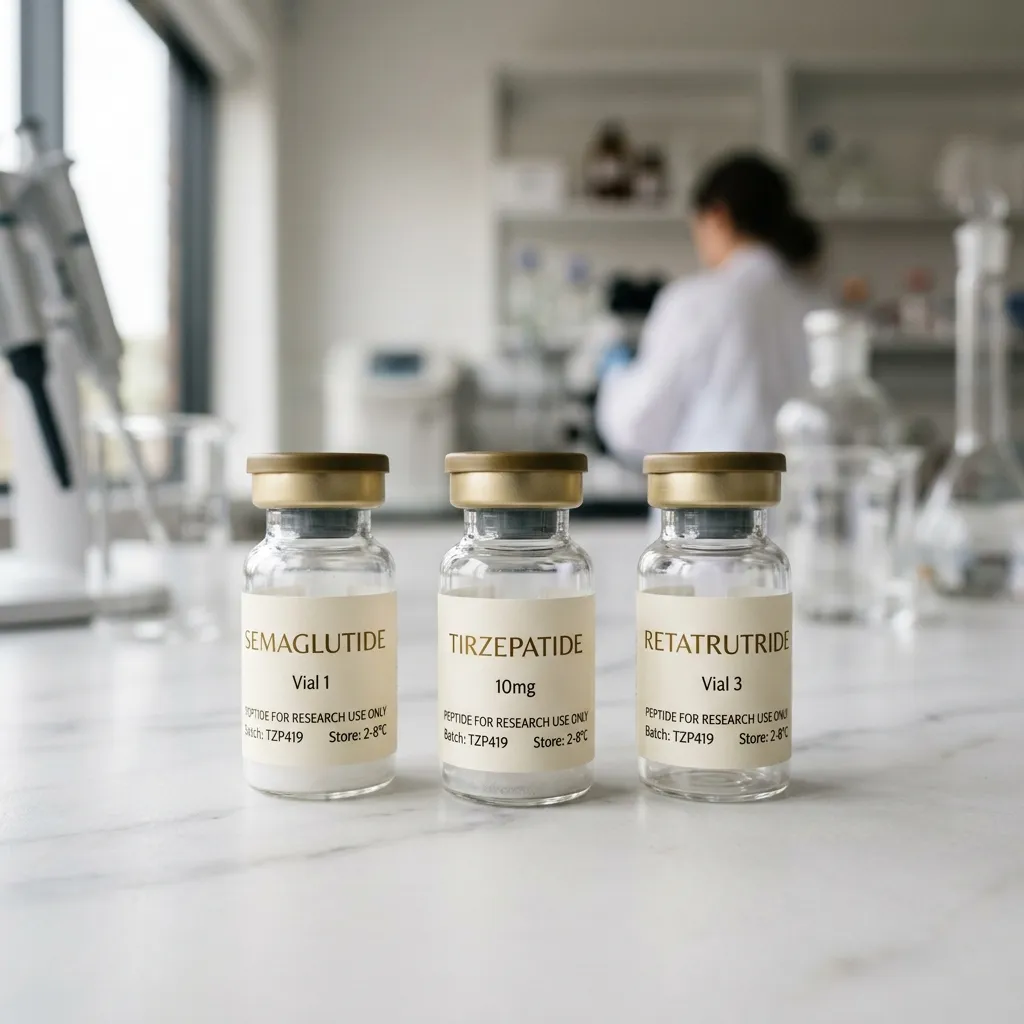
All three compounds are supplied as lyophilized powder and follow the same fundamental handling principles: reconstitute using bacteriostatic water, directing the stream gently down the vial wall and swirling rather than shaking, then refrigerate the reconstituted solution at 2-8°C. Lyophilized vials should be stored frozen at -20°C until ready for use. Given their fatty-acid modifications and long-chain structure, all three are also sensitive to mechanical agitation and repeated freeze-thaw cycling, which can promote aggregation and reduce experimental consistency. See our full Peptide Reconstitution & Storage Guide for the complete step-by-step protocol, and our Peptide Reconstitution Calculator for concentration and dosing-volume calculations specific to each compound's vial mass.
Adverse Event Signals Reported in Published Trials
Across all three trial programs, the most consistently reported adverse events in the published literature were gastrointestinal in nature — nausea, diarrhea, constipation, and vomiting — generally described as dose-dependent and more frequent during initial dose-escalation phases. The STEP, SURMOUNT, and retatrutide Phase 2/TRIUMPH trial publications each report broadly comparable gastrointestinal event rates across the three compounds, with no single compound standing out as categorically better tolerated in the published data. Cardiovascular and metabolic laboratory parameters (heart rate, blood pressure, lipid panels) were monitored throughout each program as standard trial safety endpoints. As with the efficacy data discussed above, this safety information describes the clinical trial population studied under the investigational or approved drug product and does not constitute safety data for research-grade reagent material, which is not evaluated or intended for administration to human subjects.
Beyond Triple Agonism: Where This Research Category Is Heading
Retatrutide's triple-receptor mechanism is not necessarily the endpoint of this research trajectory. Investigational compounds engaging four or more receptor targets simultaneously — sometimes referred to in the research community by shorthand designations such as GLP-3 — are already being studied as reference compounds for even broader multi-receptor pharmacology. For researchers tracking this category, our companion guide on GLP-3: Triple Receptor Agonism and What Researchers Need to Know covers how this next generation of research compounds builds on the same structural principles — albumin-binding fatty acid modifications and Aib-substituted backbones — that distinguish semaglutide, tirzepatide, and retatrutide from native incretin hormones.
Practical Considerations for Labs Stocking All Three Compounds
Laboratories maintaining semaglutide, tirzepatide, and retatrutide simultaneously for comparative research should apply a few practical safeguards beyond individual compound handling. Vials should be clearly and separately labeled by compound and lot number to prevent mix-ups during multi-cohort studies, particularly since all three share a similar lyophilized powder appearance. Maintaining a single shared administration and reconstitution log across the full comparative protocol — rather than separate logs per compound — makes it easier to audit whether an observed cross-compound difference in outcome correlates with anything other than the receptor-targeting profile itself, such as a difference in reconstitution date or storage duration between the three vials at the time of use.
Sourcing Standards at The Looksmaxxing Lab
The Looksmaxxing Lab synthesizes semaglutide, tirzepatide, and retatrutide in US-based, ISO-certified facilities, with every batch independently verified by third-party HPLC and LC-MS testing and lot-specific COA documentation published in our Certificates of Analysis Library. Researchers can review current availability across all three compounds in our shop. All products are strictly Research Use Only.
Comprehensive Frequently Asked Questions (FAQ)
What is the core difference between semaglutide, tirzepatide, and retatrutide?
The core difference is receptor coverage. Semaglutide is a single agonist that targets only the GLP-1 receptor. Tirzepatide is a dual agonist targeting both the GLP-1 and GIP receptors. Retatrutide is a triple agonist, adding glucagon receptor (GCGR) activity on top of GLP-1 and GIP. Each additional receptor target introduces a distinct metabolic pathway into the compound's mechanism, which is why they are studied as progressively more complex research models rather than interchangeable substitutes.
How does GIP receptor agonism change tirzepatide's mechanism compared to semaglutide?
GIP (glucose-dependent insulinotropic polypeptide) receptor activation works synergistically with GLP-1 signaling to enhance insulin secretion and has been associated with improved insulin sensitivity and lipid metabolism in adipose tissue research models. By engaging both receptors simultaneously, tirzepatide produces a broader metabolic signaling profile than GLP-1 agonism alone, which is the mechanistic basis researchers cite for its comparatively larger effect sizes in published trial data.
What does the added glucagon receptor component in retatrutide contribute mechanistically?
Glucagon receptor (GCGR) agonism adds a distinct hepatic pathway: it is associated with increased energy expenditure and direct stimulation of hepatic fat oxidation. In the pivotal Phase 2 trial (Jastreboff et al., 2023, NEJM), retatrutide's highest-dose cohort showed measurable reductions in hepatic fat fraction via MRI-PDFF imaging, an effect attributed specifically to this third receptor pathway rather than to GLP-1 or GIP agonism alone.
What are the molecular structures and amino acid lengths of each compound?
Semaglutide is a 31-amino-acid peptide. Tirzepatide and retatrutide are both 39-amino-acid peptides. All three share a C18 fatty diacid moiety that enables non-covalent albumin binding, which is the structural feature responsible for extending their circulating half-lives from the minutes-long half-life of native incretin hormones to a multi-day research window suitable for infrequent dosing protocols.
How do the published half-lives of the three compounds compare?
Semaglutide's albumin-binding modification extends its half-life to approximately 7 days. Tirzepatide's engineered structure produces a comparable multi-day half-life, commonly cited around 5 days. Retatrutide's alpha-aminoisobutyric acid (Aib) substitution and fatty diacid moiety similarly support an extended half-life suitable for once-weekly research dosing. Researchers should always confirm the exact figure against the specific batch's published data rather than relying on a single universal number, as reported ranges vary slightly across sources.
What did the published Phase 2 and Phase 3 trial data show for each compound?
Semaglutide's STEP trial program reported mean weight reductions of roughly 15% at 68 weeks. Tirzepatide's SURMOUNT-1 trial reported reductions of roughly 21% at 72 weeks with the highest studied dose. Retatrutide's Phase 2 trial (Jastreboff et al., 2023, NEJM) reported reductions exceeding 24% at 48 weeks in its highest-dose cohort, with Phase 3 TRIUMPH-1 topline data reported in May 2026 confirming a dose-dependent effect at 80 weeks. It is essential to understand that this trial data describes the investigational drug product studied in controlled human clinical trials — it does not describe or validate the properties of research-grade peptide material sold for laboratory use.
Which of the three compounds has the most published long-term data?
Semaglutide has the longest publication history and the largest cumulative body of trial data, having entered clinical development earliest of the three. Tirzepatide has a substantial and maturing dataset from the SURMOUNT program. Retatrutide is the newest of the three, with its evidence base still expanding through the ongoing TRIUMPH Phase 3 program, meaning its long-term data is comparatively less extensive than the other two at this stage.
Are semaglutide, tirzepatide, and retatrutide interchangeable in a research protocol?
No. Because each compound engages a different combination of receptors, substituting one for another mid-protocol introduces an uncontrolled mechanistic variable rather than a simple dose adjustment. A study designed around single-receptor GLP-1 agonism will not produce comparable data if the compound is swapped for a dual or triple agonist partway through, even at a matched administered dose.
How should researchers choose between a single, dual, or triple agonist for a given study?
Selection should follow directly from the research question. Studies isolating GLP-1 receptor signaling specifically should use semaglutide. Studies investigating GIP-GLP-1 synergy or its effect on insulin sensitivity should use tirzepatide. Studies examining glucagon-mediated hepatic effects alongside incretin signaling — such as hepatic fat oxidation or energy expenditure — require a triple agonist like retatrutide, since neither of the other two compounds engages that pathway at all.
What purity and identity verification standards should this class of compound meet?
Given the length and structural complexity of all three peptides (31 and 39 amino acids respectively), researchers should require ≥99% purity confirmed by independent third-party HPLC testing, LC-MS or ESI-MS molecular weight verification confirming structural identity, and a lot-specific Certificate of Analysis for every batch. Long-chain peptides of this size are particularly prone to truncated synthesis byproducts, making independent identity confirmation as important as the purity percentage itself.
How should semaglutide, tirzepatide, and retatrutide be reconstituted and stored?
All three follow the same general handling principles as other lyophilized research peptides: reconstitute with bacteriostatic water, direct the stream gently down the vial wall, swirl rather than shake, and store the reconstituted solution refrigerated at 2-8°C. Lyophilized (unreconstituted) vials should be kept frozen at -20°C until use. See our full Peptide Reconstitution & Storage Guide for the complete step-by-step protocol and stability windows.
Do these compounds require a prescription to purchase for research purposes?
No. The semaglutide, tirzepatide, and retatrutide offered by The Looksmaxxing Lab are classified strictly as Research Use Only (RUO) laboratory reagents. They are not FDA-approved therapeutic products, are not for human consumption, and do not require a prescription for qualified researchers procuring them for laboratory use.
Can these three compounds be studied together in a single comparative protocol?
Yes, and doing so is a common experimental design for directly characterizing differential receptor engagement. Comparative protocols typically hold dose, timing, and administration route constant across matched cohorts while varying only the compound, allowing researchers to attribute any observed differences in outcome to the specific receptor combination each compound engages rather than to procedural variance.
What are the most common confounders when comparing multi-agonist peptides in a study?
The most frequent confounders are inconsistent dosing schedules between compounds, unverified purity or identity of the research material itself, and mismatched administration technique across cohorts. Because these compounds are structurally similar but mechanistically distinct, even small procedural inconsistencies can be misattributed to a genuine receptor-driven effect. Documenting batch-level COA data and standardizing every non-compound variable is essential to isolating the true mechanistic comparison.
Where can researchers verify the purity of The Looksmaxxing Lab's semaglutide, tirzepatide, and retatrutide?
Every production batch of our semaglutide, tirzepatide, and retatrutide is tested by an independent, third-party US laboratory using HPLC and LC-MS. Lot-specific, downloadable Certificates of Analysis for all three compounds are publicly available in our COA Library.