
MOTS-C Peptide: Mitochondrial Signaling, Exercise Mimetic Research, and the AMPK Activation Pathway
MOTS-c has emerged as one of the most compelling research peptides in mitochondrial biology and metabolic science, with search interest surging 150% year-over-year as of mid-2026. Unlike the majority of research peptides — which are encoded by nuclear DNA and synthesized in the cytoplasm — MOTS-c is encoded within the mitochondrial genome itself, specifically within the 12S ribosomal RNA gene, making it a mitochondrial-derived peptide (MDP): a class of signaling molecules representing a paradigm shift in how researchers understand intercellular communication between the mitochondria and the nucleus.
First characterized by Changhan David Lee's laboratory at the University of Southern California in 2015, MOTS-c is a 16-amino-acid peptide that has demonstrated remarkable metabolic effects in preclinical models — including improved glucose homeostasis, enhanced insulin sensitivity, reduced fat accumulation, and increased exercise endurance. These properties have earned MOTS-c the designation of "exercise mimetic" in the published literature: a compound that replicates a subset of the metabolic adaptations to physical exercise at the cellular level. This article provides a comprehensive overview of MOTS-c's mechanism, preclinical evidence base, and research applications for laboratory professionals.
What Is MOTS-c? Origin and Molecular Identity
MOTS-c (Mitochondrial Open Reading Frame of the 12S rRNA Type-C) is a 16-amino-acid peptide with the sequence MRWQEMGYIFYPRKLR. It is encoded by a short open reading frame within the mitochondrial 12S rRNA gene (MT-RNR1), making it one of the first identified peptides that demonstrate a retrograde signaling pathway from the mitochondria to the nucleus — sometimes described as "mitonuclear communication." This represents a fundamental shift in the understanding of mitochondria as passive energy producers: MOTS-c demonstrates that mitochondria function as active signaling organelles capable of regulating nuclear gene expression and systemic metabolism.
Circulating MOTS-c levels have been measured in human plasma, confirming that the peptide functions as a systemic signaling molecule. Observational studies have found that plasma MOTS-c levels are negatively correlated with markers of metabolic dysfunction — including fasting insulin, HbA1c, and BMI — and that levels decline with age, paralleling the age-related decline in mitochondrial function and metabolic flexibility that characterizes cellular aging.

The AMPK Activation Pathway: How MOTS-c Produces Its Metabolic Effects
The central downstream effector of MOTS-c activity is AMPK (5' adenosine monophosphate-activated protein kinase), the master energy-sensing kinase that orchestrates cellular metabolic responses to energy stress. MOTS-c activates AMPK through a unique three-step mechanism: first, folate cycle inhibition — MOTS-c inhibits the de novo purine synthesis pathway by reducing methylenetetrahydrofolate availability; second, AICAR accumulation — this inhibition causes accumulation of AICAR, an endogenous metabolite and well-established AMPK activator; and third, AMPK phosphorylation — elevated AICAR activates AMPK, triggering the downstream metabolic cascade without requiring cellular energy depletion, the mechanism that distinguishes MOTS-c from exercise-induced AMPK activation.
Activated AMPK then drives a metabolic response profile that closely mirrors cellular adaptations to aerobic exercise training: enhanced insulin-independent glucose uptake through GLUT4 translocation, upregulated fatty acid oxidation through CPT-1 pathway activity, and activation of PGC-1α-mediated mitochondrial biogenesis programs. Lee et al. (2015) measured GLUT4 surface expression and AMP:ATP ratio changes in MOTS-c-treated skeletal muscle cells, directly confirming the exercise-mimetic pathway at the molecular level.
Nuclear Translocation: The Stress-Response Pathway
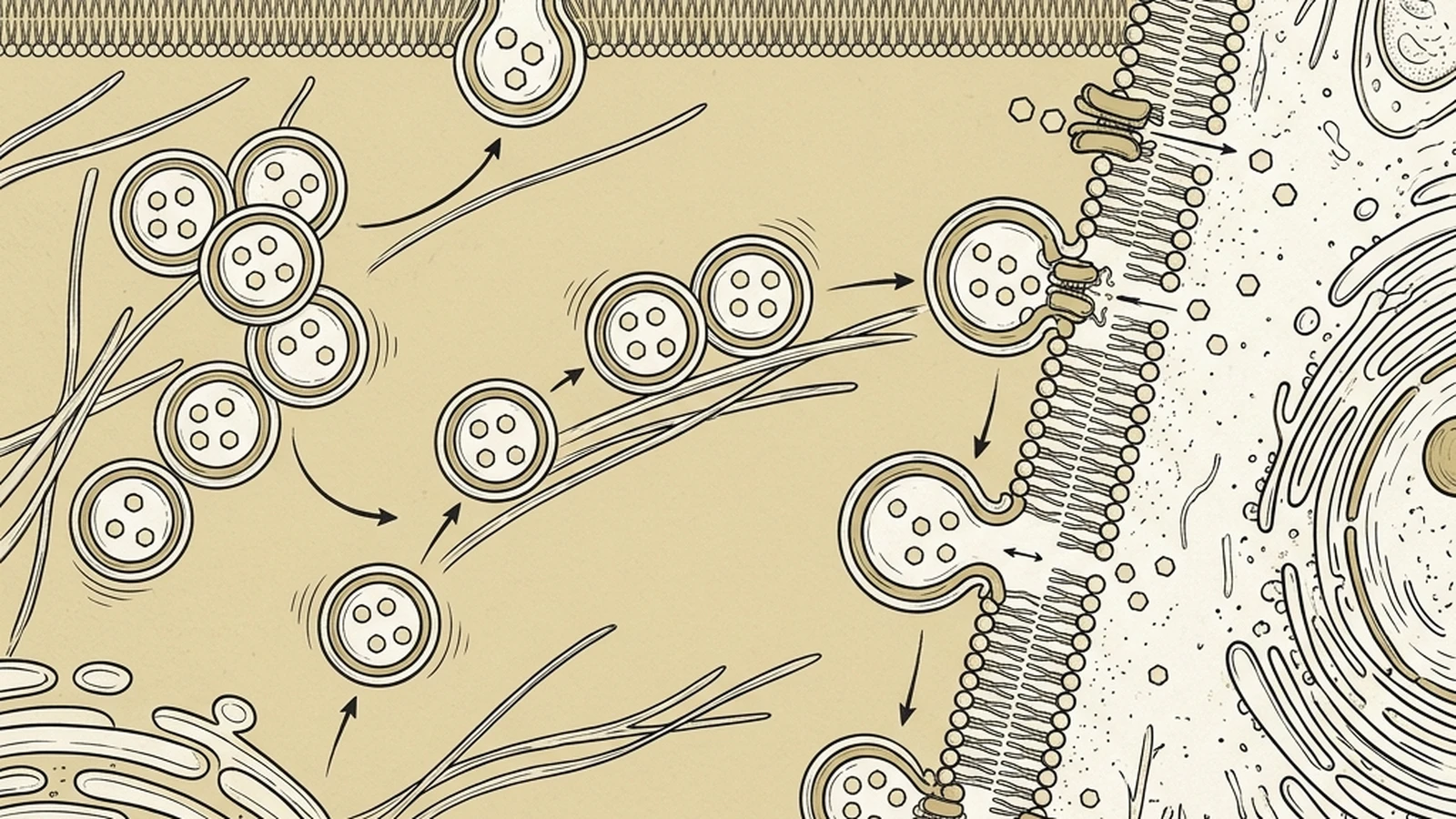
One of the most significant findings in MOTS-c research is the demonstration that MOTS-c translocates from the cytoplasm to the cell nucleus under conditions of metabolic stress — observed in response to glucose deprivation, oxidative stress, and serum starvation in cell models. Once in the nucleus, MOTS-c interacts with transcription factors and chromatin-modifying complexes to directly regulate the expression of genes involved in antioxidant defense, stress adaptation, and metabolic homeostasis. This establishes MOTS-c as more than a circulating signaling peptide — it is a direct nuclear effector that can reprogram gene expression in response to metabolic challenges.
Exercise Mimetic Properties: What Preclinical Models Show
In diet-induced obese mouse models, exogenous MOTS-c treatment improved fasting glucose levels and glucose tolerance to a degree comparable to exercise-mediated improvements, mediated by increased skeletal muscle glucose uptake. Treated animals also showed reduced fat mass accumulation on high-fat diets without significant changes in food intake, indicating a metabolic mechanism rather than appetite suppression — distinguishing MOTS-c from GLP-1 receptor agonists, which primarily reduce body weight through centrally mediated appetite suppression.
In aged mouse models, exogenous MOTS-c administration restored metabolic flexibility and physical performance metrics — including treadmill endurance — that typically deteriorate with age-related mitochondrial decline. Research published in Frontiers in Physiology (2025) further demonstrated that MOTS-c restored mitochondrial respiration in type 2 diabetic cardiac tissue models, expanding research interest into cardiac metabolism.
MOTS-c vs. Other Metabolic Peptides: Where It Fits in the Research Landscape
| Peptide | Primary Mechanism | Receptor/Pathway | Research Stage |
|---|---|---|---|
| MOTS-c | AMPK via purine synthesis inhibition | Mitochondria → nucleus (no membrane GPCR) | Preclinical + Phase 1 |
| Semaglutide | GLP-1R agonism | GLP-1R (GPCR) | Approved (2017) |
| Retatrutide | Triple GLP-1/GIP/GCGR agonism | GLP-1R + GIPR + GCGR | Phase 3 |
The key distinction is that MOTS-c operates through a fundamentally different mechanism than GPCR-based metabolic peptides — it does not bind a membrane receptor and trigger a signaling cascade, it activates AMPK through metabolic pathway inhibition and directly enters the nucleus to regulate gene expression. This makes MOTS-c mechanistically orthogonal to the incretin class, positioning it as a complementary research compound rather than a competitor within the same pathway. Researchers investigating MOTS-c alongside the hormonal-metabolic axis in female physiology models should also see our companion article, Kisspeptin-10 & MOTS-C: Research Peptides and the Female Hormonal-Metabolic Axis.
Age-Related MOTS-c Decline: Implications for Aging Research
Multiple observational studies have documented that circulating MOTS-c levels decline with age in humans, paralleling the broader age-related deterioration in mitochondrial function central to current theories of biological aging. Additional observational data has shown that obese children have significantly lower circulating MOTS-c levels, and that plasma MOTS-c concentrations in adult males are negatively correlated with fasting insulin, HbA1c, and BMI. A meta-analysis of over 27,500 subjects identified an Asian-specific mitochondrial DNA variant (m.1382A>C) that alters the MOTS-c amino acid sequence and is associated with higher type 2 diabetes prevalence in males, providing genetic evidence for a functional link between MOTS-c biology and metabolic disease susceptibility.
Research-Grade Sourcing and Handling
Given MOTS-c's 16-amino-acid length, synthesis fidelity and post-synthesis purification are critical for experimental reproducibility — even a single amino acid deletion or substitution represents a proportionally large structural change that could alter biological activity. Researchers should verify ≥99% HPLC purity confirmed by independent third-party testing, LC-MS molecular weight verification matching the target MOTS-c sequence (MRWQEMGYIFYPRKLR), and lot-specific COA documentation with every batch.

The Looksmaxxing Lab supplies research-grade MOTS-c, synthesized in US-based, ISO-certified facilities with full independent verification. Lot-specific Certificates of Analysis are accessible in our public COA library. For reconstitution and storage protocols, consult our Peptide Reconstitution and Storage Guide, and use the Peptide Calculator for precise concentration calculations.
Comprehensive Frequently Asked Questions (FAQ)
What is MOTS-c peptide?
MOTS-c (Mitochondrial Open Reading Frame of the 12S rRNA Type-C) is a 16-amino-acid peptide encoded by the mitochondrial genome. It is classified as a mitochondrial-derived peptide (MDP) and functions as a systemic metabolic regulator. In preclinical models, MOTS-c activates AMPK, improves glucose homeostasis, and replicates metabolic adaptations associated with physical exercise — earning the designation of exercise mimetic in the published literature. It is for research use only.
How does MOTS-c activate AMPK?
MOTS-c activates AMPK by inhibiting the folate cycle and de novo purine synthesis pathway, causing accumulation of AICAR (5-aminoimidazole-4-carboxamide ribonucleotide), a potent endogenous AMPK activator. This mechanism allows AMPK engagement without requiring cellular energy depletion, distinguishing it from exercise-induced AMPK activation.
Why is MOTS-c called an exercise mimetic?
Preclinical research shows that MOTS-c administration reproduces key metabolic adaptations associated with aerobic exercise training — including enhanced insulin sensitivity, increased GLUT4 translocation, upregulated fatty acid oxidation, and activation of PGC-1α-mediated mitochondrial biogenesis. MOTS-c levels are also naturally upregulated during physical exercise in both rodent and human models.
Does MOTS-c decline with age?
Yes. Multiple observational studies have documented that circulating MOTS-c levels decline with age in humans. This decline parallels age-related reductions in mitochondrial function, metabolic flexibility, and exercise capacity, supporting the research hypothesis that MOTS-c restoration could attenuate metabolic aging.
What is the difference between MOTS-c and GLP-1 peptides?
MOTS-c and GLP-1 peptides operate through fundamentally different mechanisms. GLP-1 peptides bind to membrane-bound GLP-1 receptors and trigger GPCR signaling cascades primarily involving appetite suppression and insulin secretion. MOTS-c activates AMPK through metabolic pathway inhibition and translocates to the cell nucleus to directly regulate gene expression. MOTS-c reduces body weight through metabolic mechanisms rather than appetite suppression, making the two compound classes mechanistically complementary for research purposes.
Where can I buy MOTS-c peptide for research?
The Looksmaxxing Lab supplies research-grade MOTS-c synthesized in US-based, ISO-certified facilities with ≥99% HPLC purity, LC-MS identity verification, and lot-specific COA documentation. All products are for research use only.